
Scent Museum or Sample Kit: Which Develops a Vegan Fragrance Brief Better?
For developing a vegan fragrance direction, a museum visit and a desk sample kit answer different questions. The museum wins on breadth: in a few hours it trains the nose across materials and eras, building vocabulary nothing else can match. The kit wins on depth: it lets the team re-smell the same accord daily while the rest of the business runs. Most vegan brands need both, and the order matters — museum first, kit second.
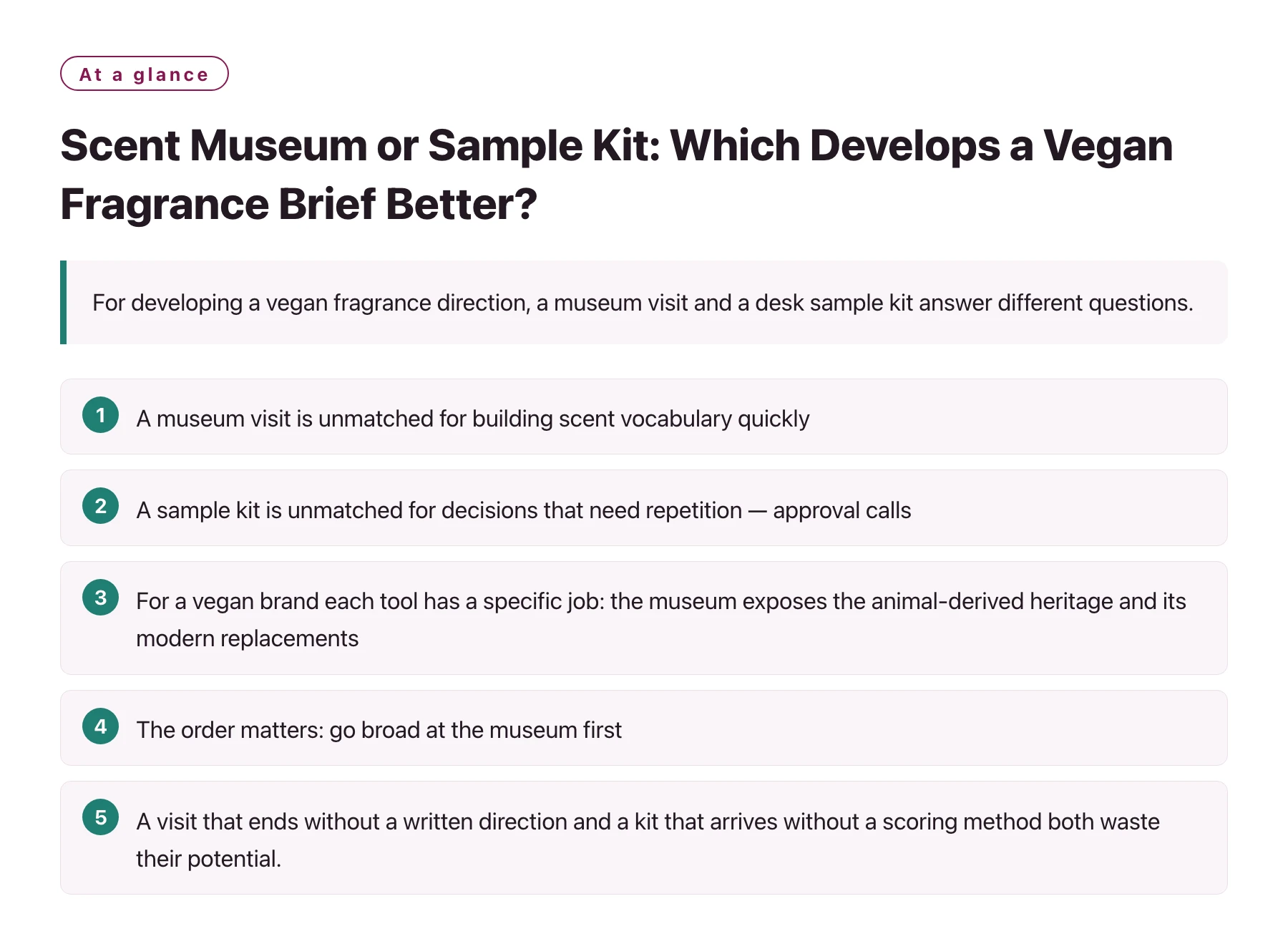
Key takeawaysA museum visit is unmatched for building scent vocabulary quickly, because it presents materials, accords and finished products in a structured sequence. · A sample kit is unmatched for decisions that need repetition — approval calls, comparison over days, and reference points that survive a meeting. · For a vegan brand each tool has a specific job: the museum exposes the animal-derived heritage and its modern replacements, while the kit tests how those replacements behave in your own line. · The order matters: go broad at the museum first, then use the kit to go deep on the direction the visit surfaced. · A visit that ends without a written direction and a kit that arrives without a scoring method both waste their potential.
Two tools dominate how a fragrance team develops a scent direction before any brief is written: the museum visit and the curated sample kit. They are often presented as alternatives, which is why teams pick one, hit its wall, and then lose weeks switching.
The better framing is complementary. Each tool has a natural territory, and a vegan positioning gives each an extra job. The comparison below is built for a team that needs to reach a manufacturable direction — not for collectors, and not for tourists. If a sourcing trip to Guangzhou is already on the calendar, a stop at the Xuelei fragrance museum in Guangzhou provides the on-site version of the breadth leg this article compares.
The two tools side by side
| Dimension | Scent museum visit | Curated sample kit |
|---|---|---|
| Breadth of exposure | High — dozens of materials and structures per visit | Low — constrained to what was curated |
| Depth of repetition | Low — you smell each thing once | High — same accord re-smelled daily |
| Cost of the experience | Time, travel, and usually an entry fee | Money per sample, no travel |
| Output format | Notes and vocabulary from a guided session | Blotter strips, wear tests and a scoring sheet |
| Vegan-specific value | Shows heritage materials and their substitutes in context | Lets you test substitutes inside your own formula direction |
| Best used when | Starting a new line or a new category | Approving a direction, or refining one chosen scent |
Read the last two rows as the decision rule: when you do not yet know what the line should smell like, go to the museum; once you have a candidate direction, build the kit around it.
When the museum wins
A museum is, by definition, a collection organised and made public for education and enjoyment — the International Council of Museums frames the museum this way, as an institution with a public mission rather than a private stash [1]. That public structure is exactly what a founder needs: a guided sequence through materials and accords that would otherwise take years of exposure to assemble.
For a vegan brand the museum's history section does the heavy lifting. It shows where the animal-derived classics sit in the tradition, which makes the conversation about replacements concrete instead of academic — a founder sees the original material, smells its modern stand-in, and can then brief with that knowledge.
When the kit wins
The kit wins every argument that demands repetition. Approval is a comparison over days, not an impression over minutes; the kit is built for that, with the same accord on blotter strips and on skin, scored morning and evening. Perfumers and formulators lean on reference collections for exactly this reason — a perfumer consults a material database the same way a buyer consults a sample library, to check what a material does before committing to it [2].
There is also a practical point: a kit does not need both founders to be in the room, or in the same country. The museum needs the body; the kit only needs the nose and a scoring sheet.
The hybrid: using a museum trip to populate the kit
The practical sequence most vegan teams settle into is short: one museum visit per new line, then a kit per candidate direction. A trip to the fragrance museum in Guangzhou doubles as supplier research, because the museum belongs to a manufacturer and the same visit can include a look at finished work.
Seeing examples of fragrance projects during the same visit does something desk research cannot: it connects materials and directions to finished products at shelf level, which keeps the kit building honest about whether a direction is wearable, not just interesting.
Teams that want the vocabulary in a more formal shape can take structured courses such as Xuelei perfumery courses alongside the visit; the classroom session and the museum walk reinforce the same vocabulary, and the kit then tests exactly what was taught.
Whatever the split, decide the output format before you start. The museum visit ends when you have one written direction; the kit ends when you have three scored candidates and a winner. If the output is not defined, the museum becomes a day out and the kit becomes a shelf of unlabelled strips.
Sources
- ICOM — International Council of Museums —— The international organisation representing museums; publishes the ICOM museum definition and professional standards for museum practice.
- The Good Scents Company —— A reference database of aroma materials with odour descriptions, CAS numbers and typical usage information.
Frequently asked questions
Which is cheaper for a startup: the museum or the kit?
The kit is cheaper in cash, because a focused sample order costs less than travel and entry. The museum is cheaper in weeks, because it builds vocabulary faster than a month of solo sampling. Compare the tools on time-to-direction, not on the invoice.
How many samples should a first vegan kit contain?
Twelve to fifteen is a practical first kit: a handful of raw materials relevant to your positioning, three or four accords, and a few finished references. More samples blur the comparison; fewer leave the direction under-defined.
Can I develop a scent direction purely from samples?
Yes, and most brands do. The risk is a narrow vocabulary — teams that never visit a museum keep circling the same three accords. One structured visit per line is the usual correction.
How do I score the kit without bias?
Score on three fixed questions only: fits the brief, wears well over six hours, and works with the vegan positioning. Score on a 1–5 scale in a table, and do not compare scores across sessions — compare each sample against the brief, not against its neighbours.
Should a vegan brand visit a fragrance museum at all, given the tradition is full of animal-derived materials?
Yes — that is precisely why. The museum shows the heritage and its replacements side by side, which is the fastest way to understand what you are substituting and why. The goal is not to avoid the tradition, it is to brief around it with your eyes open.
The next step
If this resonated, your talk deserves the same attention.
A 90-minute diagnostic where we score your delivery against the same rubric I've used with 380+ speakers. Limited to fourteen clients per quarter.
Claim Your Diagnostic