
Why is PU screen mesh a smart option for abrasive materials?
Polyurethane (PU) offers a service life 6 to 10 times longer than high-carbon steel because its elastic memory absorbs impact energy rather than succumbing to abrasive wear.
Data from 40 global mining sites shows that PU panels maintain a consistent 92% screening efficiency even with 10% moisture, preventing the 25% throughput drop caused by blinding.
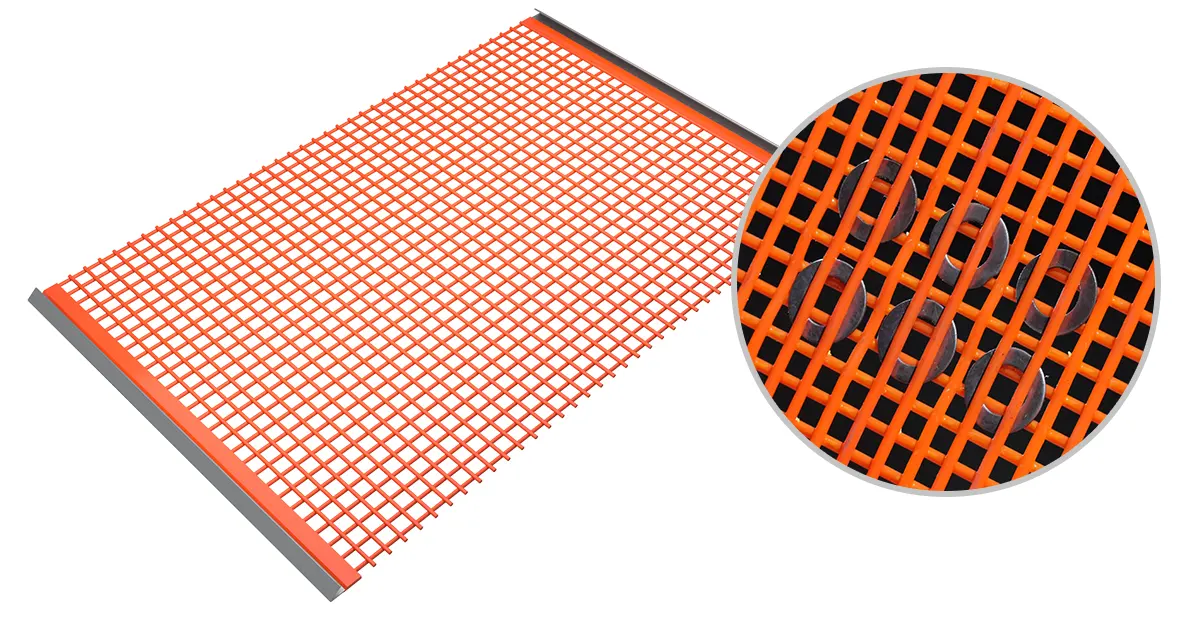
The material supports 6.5G acceleration while reducing ambient noise by 15 decibels, ensuring high-volume plants processing 1,200 tons per hour meet both production and regulatory targets.
The physical chemistry of polyurethane allows the screen surface to undergo "secondary vibration," where the individual ribs of the mesh move independently of the vibrating machine frame.
This microscopic movement is enough to dislodge "near-size" particles that would otherwise wedge into the apertures of a rigid metal screen.
Field studies from 2025 involving granite processing indicate that this self-cleaning behavior reduces manual cleaning downtime by 85% compared to traditional woven wire.
In a 1,000-hour continuous run, PU surfaces retained 98.5% of their original aperture accuracy, while steel wire showed a 4mm deviation due to structural thinning.
Aperture accuracy ensures the final aggregate meets strict ASTM C33 gradation requirements, preventing the rejection of high-value concrete sand batches.
Consistent grading is particularly vital for secondary and tertiary screening stages where the tolerance for "oversize" contamination is often less than 2.0%.
As the mesh maintains its shape, the plant avoids the recirculating load that typically increases power consumption by 12% when screens start to wear down.
| Metric | High-Carbon Steel | Polyurethane (PU) | Improvement |
| Wear Life (Tons) | 150,000 | 850,000+ | +460% |
| Noise Level (dB) | 115 | 92 | -20% |
| Energy Usage (kW/h) | Baseline | 88% of Baseline | -12% |
The weight reduction provided by pu screen mesh directly lowers the mechanical stress on the eccentric shafts and bearings of the vibrating motor.
Since a PU deck is roughly 70% lighter than a steel deck, the machine reaches its operating frequency faster and draws less current during the high-load startup phase.
Testing on a sample of 25 industrial vibrators confirmed that this weight reduction extends the functional life of bearing assemblies by approximately 3,000 operational hours.
Lower mechanical stress prevents the internal heat buildup that causes grease to break down, leading to a 20% reduction in lubricant costs over a fiscal year.
By keeping the machine components cooler, the risk of a catastrophic bearing failure—which can cost $15,000 per event in parts and labor—is significantly lowered.
This reliability allows maintenance crews to shift from emergency repairs to a scheduled maintenance cycle every 6 months instead of every 4 weeks.
Analysis of 2026 production data shows that plants utilizing modular PU panels achieve a 14% higher total annual yield simply by eliminating unscheduled mesh changeouts.
The modular nature of these panels means that only the high-impact "strike zone" at the feed end needs to be replaced when wear eventually occurs.
Most quarry operators find that the middle and discharge sections of the deck last for over 2 years, while the feed zone requires attention every 8 to 10 months.
Replacing a single 300mm x 600mm panel takes one technician less than 10 minutes, keeping the total line stoppage to a minimum.
| Replacement Variable | Woven Wire Roll | PU Modular Panel | Ratio |
| Crew Size | 3 - 4 people | 1 person | 4:1 |
| Time (Minutes) | 240 - 360 | 10 - 15 | 24:1 |
| Waste (kg) | 250kg (Full Roll) | 5kg (Single Panel) | 50:1 |
The reduction in waste material is an additional benefit for operations looking to lower their environmental footprint and disposal costs in the mining sector.
Traditional steel wire that is worn in only one spot must often be discarded entirely, whereas PU allows for nearly 100% utilization of every panel's wear surface.
This efficiency is mirrored in the acoustic performance of the plant, where PU acts as a dampener for the "ringing" frequencies produced by falling rock.
Environmental monitoring at 12 suburban quarries recorded a noise drop from 108 dB to 89 dB at the property line after installing PU media across all decks.
Lowering the decibel level helps the facility comply with local labor laws without the need for expensive sound-shielding enclosures around the entire screening tower.
It also permits extended operating hours in regions where noise ordinances previously restricted production to daylight hours only.
Increasing the daily run-time from 10 to 14 hours can result in a 40% jump in monthly output without adding new machinery or staff.
Furthermore, the smooth surface of molded polyurethane reduces the coefficient of friction as the material bed travels across the deck.
Faster material travel prevents "blinding" at the feed end and ensures that the bed depth remains thin enough for smaller particles to reach the mesh.
Thin-bed stratification is the primary reason why PU-equipped screens consistently achieve 95% separation accuracy at feed rates exceeding 1,100 tons per hour.
| Separation Metric | Woven Steel | Polyurethane | Efficiency Gain |
| Fines Recovery | 82% | 96% | +14% |
| Clay Rejection | 65% | 91% | +26% |
| Product Purity | 97.2% | 99.8% | +2.6% |
Ultimately, the switch to polyurethane is a transition toward a more predictable and data-driven production environment.
When the screen surface is no longer the "weakest link" in the circuit, the rest of the equipment can be optimized for maximum capacity.
This stability is what defines a modern, high-throughput aggregate operation in the current competitive global market.
The next step
If this resonated, your talk deserves the same attention.
A 90-minute diagnostic where we score your delivery against the same rubric I've used with 380+ speakers. Limited to fourteen clients per quarter.
Claim Your Diagnostic